Cash out now… or Risk one more Pump?
Life is full of curious situations that test the way we think, observe, and react, and one riddle in particular captures our attention through its simplicity and deeper complexity: “Who will fall first?” This question isn’t just about guessing—it’s a challenge that asks us to use logic, perception, and reasoning to analyze a seemingly straightforward scene.
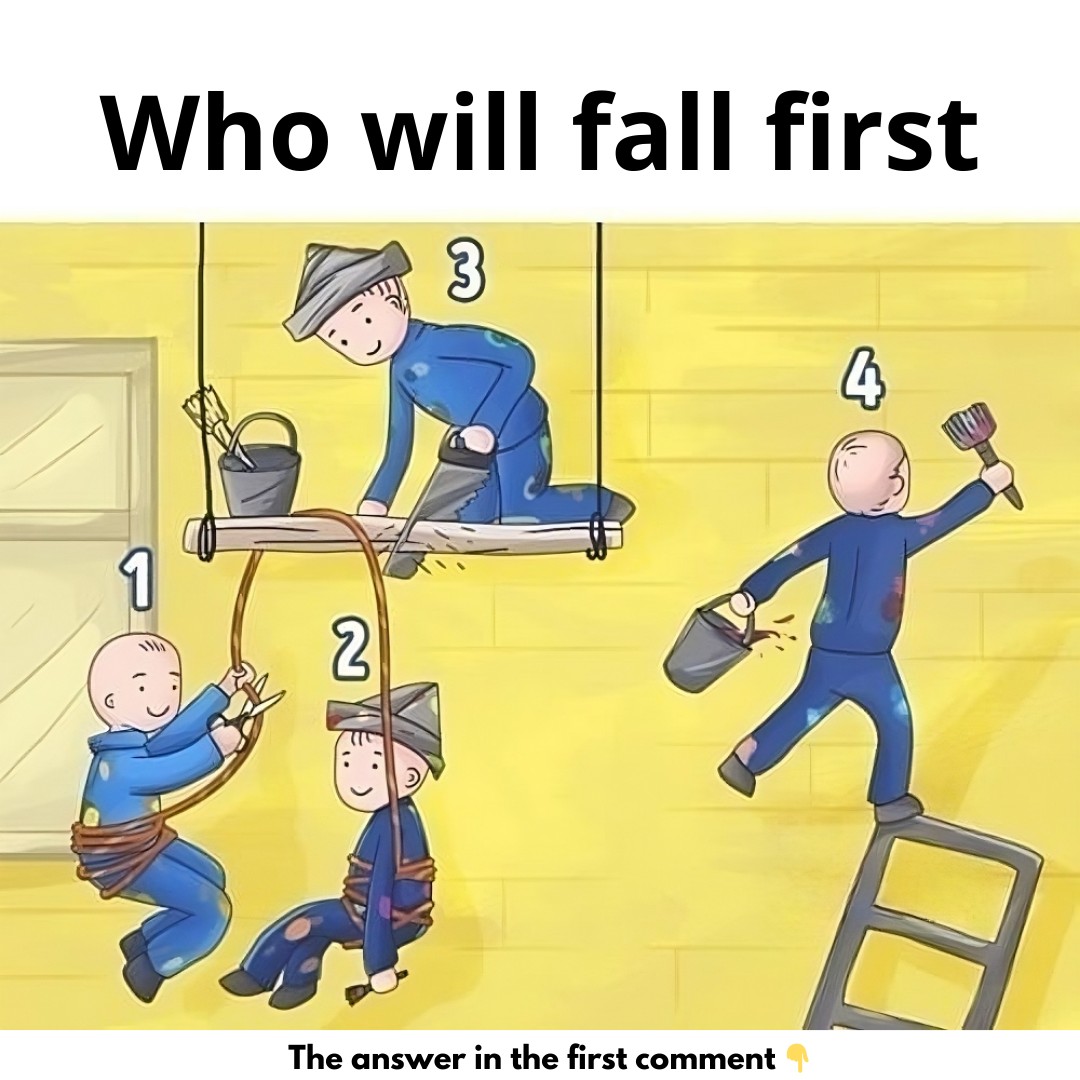
Imagine four painters, each placed in a different, somewhat risky position while working on a yellow wall. Painter #1 stands firmly on the ground, holding a rope that suspends a wooden plank above the ground. Painter #2 is sitting comfortably on that suspended plank, fully dependent on the rope being held by Painter #1. Painter #3 is standing on the same plank as Painter #2, but he’s actively sawing it in half, compromising its stability. Then there’s Painter #4, who is up on a ladder, holding a paint bucket and painting the upper section of the wall. At first, it might seem obvious who will fall first, but that’s the trick—puzzles like this are designed to make us second-guess our instincts.
Many people rush to say that Painter #3 will fall first because he’s literally cutting the platform he’s standing on, but that assumption overlooks important factors. Sawing through a plank doesn’t happen instantly; it takes time, and during that time, something else could go wrong for someone else. That’s one of the most common pitfalls in logic puzzles: jumping to conclusions without thoroughly analyzing the entire situation. Another mistake is ignoring critical details, such as the stability of the ladder or how secure the rope is. Sometimes, the most obvious answer isn’t the right one because these puzzles often depend on subtle cues and an understanding of basic physics like gravity, balance, and cause and effect. So let’s break down the situation for each painter to determine who’s really in the most immediate danger.
Painter #4, standing on a ladder and trying to balance a bucket of paint while painting, is clearly in a precarious position. Ladders are inherently unstable, and when you add the extra weight of a paint bucket and the need for careful movement, the chances of slipping or tipping increase dramatically. One slight misstep, and Painter #4 could easily lose balance and fall. This makes their risk of falling high. Painter #3, although taking a dangerous action by cutting the plank, is still relying on the time it takes to complete the sawing. If he doesn’t finish cutting immediately, he won’t fall immediately. That puts his risk level at moderate—significant but not instant.
Painter #2 is just sitting on the plank and isn’t causing any instability themselves. Their safety depends on whether the plank is cut or if Painter #1 loses grip of the rope. That makes Painter #2’s situation passive, with a lower risk of falling first. As for Painter #1, they’re standing safely on the ground and simply holding the rope. Unless something causes them to let go or drop the rope, they’re not in any danger of falling at all, making their likelihood of falling minimal. With all these factors considered, it becomes clear that Painter #4 is the most likely to fall first. Their position is the most unstable, and the risk of the ladder slipping or tipping under their weight is immediate.This kind of puzzle is a fantastic example of how we process and evaluate information. It challenges us to slow down, consider every variable, and think through cause-and-effect relationships. It trains us to pay attention to small details that might otherwise go unnoticed and encourages us to think critically about what’s happening in the scene. More than just being a fun challenge, puzzles like this also help improve logical thinking, sharpen observation skills, foster patience, and promote creative problem-solving. “Who will fall first?” might sound like a simple question, but when you peel back the layers, it becomes a fascinating exercise in balance, logic, and awareness. The conclusion points to Painter #4 as the one most likely to fall first, thanks to the unstable ladder and added risk of the paint bucket. But what makes puzzles like this so compelling is that they invite us to think deeper, share our interpretations, and sometimes even debate the possibilities. So, do you agree with this conclusion, or do you see it differently? Let the thinking—and the conversation—begin.