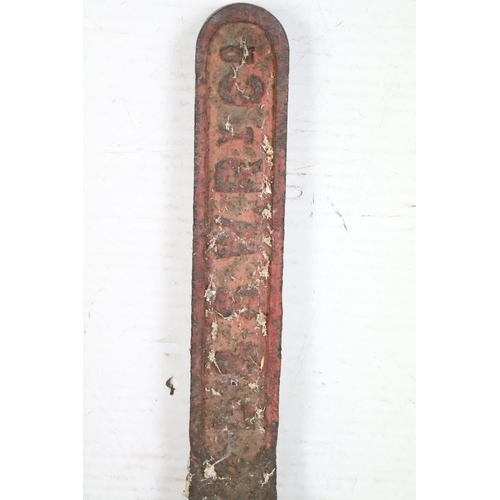
Sometimes, the most fascinating discoveries are found in the most unexpected places. What begins as an ordinary construction project can suddenly turn into a journey into the past, revealing something that has remained hidden for generations. That is exactly what happened when workers began excavating the ground to prepare the foundation for a new home. As the heavy machinery moved deeper into the soil, they uncovered something unusual: a large, heavy metal object covered in thick layers of rust. At first glance, it looked like an abandoned piece of scrap metal, but its unusual shape immediately caught their attention. Unlike the ordinary debris often found during construction, this object seemed to have a purpose, and perhaps even a story worth discovering.
Curiosity soon led to a closer examination. Although years of exposure to moisture and soil had damaged its surface, the object’s distinctive design appeared remarkably similar to antique cast-iron boundary markers. These markers were once used to identify property lines and establish the limits of privately owned land, long before modern surveying equipment and digital property records became common. They served as important reference points, helping landowners understand where one property ended and another began. Could this forgotten metal piece have once stood proudly at the edge of an old property? Perhaps it had marked a boundary for generations before being buried, covered by changing landscapes, and eventually forgotten. But the more interesting question was what this mysterious object could reveal about the land’s history…
If the object really is an old boundary marker, it could represent a small but meaningful connection to the people who lived and worked on this property long before the new house was ever imagined. Land boundaries were once carefully established using physical markers, and some of these objects have survived for decades or even centuries. They can offer clues about how communities developed, how properties changed ownership, and how familiar landscapes were divided in earlier times. What makes discoveries like this particularly fascinating is that they transform an ordinary piece of land into something much more personal. Beneath the soil, there may be traces of forgotten decisions, old property divisions, and the everyday lives of people whose names have disappeared from local memory. Even a weathered piece of iron can become a valuable historical clue when its origins are properly investigated.
Of course, its exact identity, age, and original purpose have not yet been established. A closer inspection, measurements, historical property documents, and comparisons with documented examples would be needed before anyone could confidently identify it. Its value as a collectible, if any, would also depend on its authenticity, condition, rarity, and documented history. Still, perhaps its greatest appeal has nothing to do with money. Imagine beginning construction on a modern family home, only to discover that the ground beneath it holds a reminder of an entirely different time. What once seemed like an ordinary piece of rusted metal might actually preserve a small fragment of the property’s forgotten past. And sometimes, the most remarkable part of a discovery is not what we find, but the stories it inspires us to uncover.