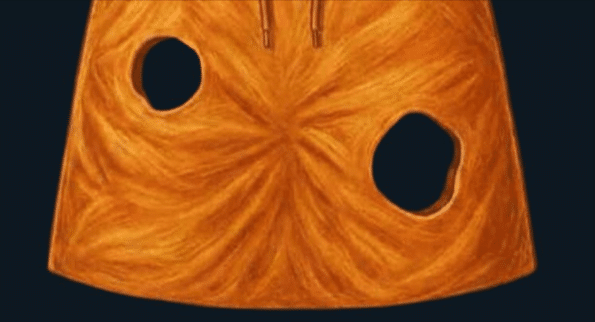
Internet puzzles have a talent for turning the simplest image into a full-scale argument, and this skirt riddle is a perfect example of why people get so hooked. At first, it seems almost too easy. You see a skirt, notice a few obvious tears, and read a question that sounds completely straightforward: How many holes are in the skirt? But almost immediately, certainty disappears. People start staring longer, counting again, zooming in, and insisting their answer is the only one that makes sense.
That is exactly why this puzzle has become such a popular little obsession online.
The image invites viewers to count the holes in the skirt, with answer choices ranging from 2 to 7. Some people go straight for 2 because they only count the two large visible tears on the front. Others argue that the answer should be 4, reasoning that if those tears go all the way through the fabric, then both the front and back are affected. Then another group takes it even further by including the waistband opening and the bottom opening, which changes the total again.
What starts as a simple visual becomes a logic test almost instantly.
That is what makes these kinds of brain teasers so addictive. They are not really about eyesight alone. They also force people to decide what counts as a hole in the first place. Are you only counting damage? Are you counting every opening in the garment? Should the two small drawstring openings near the waistband be included too? That is where the debate really begins, and often the reactions in the comments become more entertaining than the puzzle itself.
One of the most common ways people explain the puzzle is by breaking the skirt down into all of its openings. There is one hole at the top where someone puts it on, one opening at the bottom, and the two visible tears in the fabric. If those tears pass through both layers, then some viewers count them as four holes rather than two because each tear affects the front and the back. And once the small drawstring holes near the waistband are added into the mix, the total jumps even more quickly.
That is why people can land on completely different answers and still feel absolutely convinced they are right.
Of course, the dramatic line suggesting that the answer somehow determines whether someone is a narcissist is nothing more than clickbait-style humor. A puzzle like this cannot reveal anything meaningful about a person’s mental health, personality, or character. Its purpose is much simpler: to grab attention, spark curiosity, and make people stop scrolling long enough to join the debate. In that sense, it does exactly what it was designed to do.
These kinds of viral visual riddles spread so easily because they invite instant participation. People love giving their answer, arguing their logic, and comparing it with everyone else’s. Even when there is no official or universally accepted solution, the image still succeeds because it creates conversation. In reality, that is the real point. The puzzle is not so much about finding one perfect answer as it is about making people question what looked obvious at first glance.
Another reason these riddles perform so well online is that they feel accessible. Anyone can take part. You do not need expert knowledge, complicated formulas, or deep analysis. All it takes is a few seconds, a little attention, and a willingness to debate tiny details with total confidence.
So what is the best answer? That really depends on how you define the word hole. If you only count the obvious tears, you might say 2. If you believe those tears go through both sides of the skirt, then 4 may feel more accurate. If you include the top opening, the bottom opening, and perhaps the small drawstring openings as well, the number rises again. That is what gives the puzzle its charm. It is not just asking what you see, but how you think about what you see.
In the end, the real challenge is not the skirt itself.
It is the way the mind chooses to interpret and count what is right in front of it.